How to Choose the Best Faux Plants for Your Home (Size, Style & Placement Guide)
November 11, 2026 · 777 words · faux plants, interior styling, buying guide, artificial plants
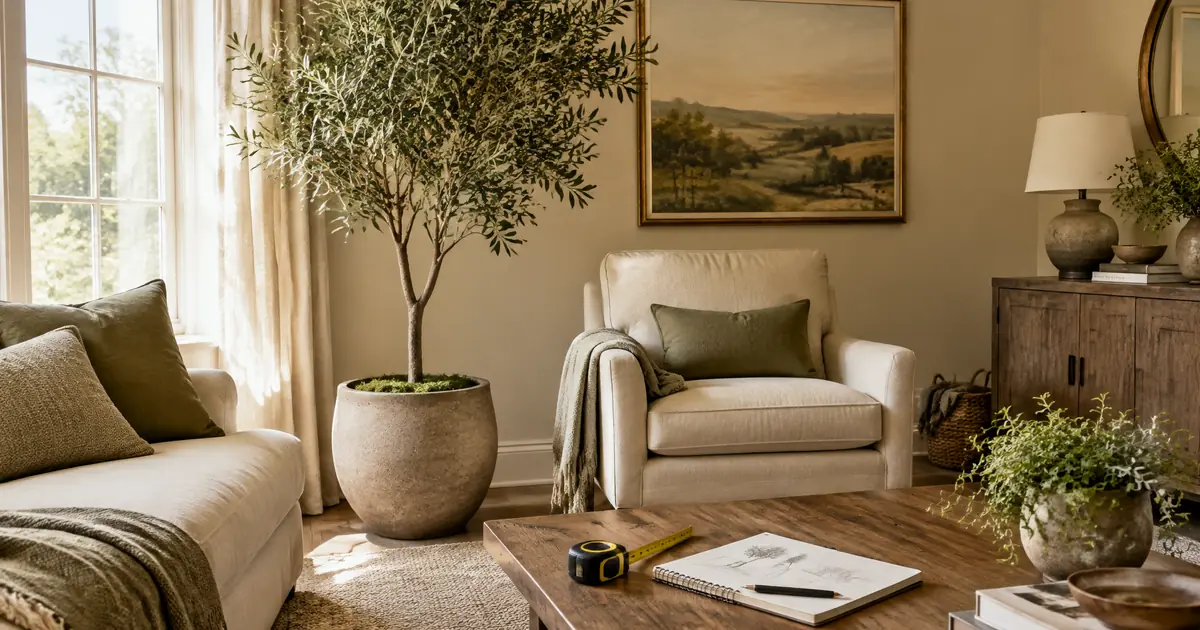
Walk into a room with the right faux plant and nobody asks if it's real. Walk in with the wrong one and it reads as decor you forgot to take down. The difference is rarely the plant itself; it's size, proportion and placement. This guide walks through how to choose artificial plants that look intentional in your space, from ceiling height and pot scale to the rooms where faux greenery quietly outperforms the real thing.
Start with the height of your room, not the plant
The most common faux-plant mistake is buying too small. A 3-foot tree in a room with 9-foot ceilings floats awkwardly and draws attention to everything around it. As a rule of thumb:
Floor plants and trees
For rooms with standard 8-foot ceilings, choose trees between 4 and 6 feet tall. Taller rooms, stairwells and two-story entries can carry 6 to 7 foot trees without crowding. Our 2'-3'-4' Milan Grass Spiral Topiary and Porch Cedar Tree both come in multiple heights so you can scale to the room instead of forcing one size everywhere.
Tabletop and shelf plants
Anything under 24 inches belongs on a surface: consoles, mantels, bathroom counters. Keep the plant roughly one-half to two-thirds the height of the object beside it so the grouping reads as a composition rather than a lineup.
Match the style of plant to the style of the room
Faux greenery comes in as many personalities as real plants. The trick is matching the leaf shape and pot to what is already in the room.
Modern and minimalist rooms
Clean-lined topiaries and structured trees work best. The sharp spiral of a Milan grass topiary suits geometric furniture and monochrome palettes because the plant adds one clear shape instead of visual noise.
Traditional, farmhouse and cottage rooms
Softer silhouettes fit here: cedar, cypress and Norfolk pine. The feathery texture of our Norfolk Pine Trees softens straight lines and pairs naturally with wood furniture and woven textiles.
Entryways, porches and symmetrical spots
Pairing two matching trees on either side of a door is one of the oldest staging tricks because it works. Our Classic Porch Cedar Trees are sold in pairs for exactly this reason, and the 5ft Cedar Topiary gives you a taller option for grander entries.
Placement: light, sightlines and breathing room
Because artificial plants tolerate any light, you get to place them where they look best rather than where they'd survive.
Use them to anchor dead zones
Every home has them: the corner the sofa doesn't fill, the wall beside the TV, the spot where the radiator rules out a real plant. A floor tree fills these gaps and makes the whole room feel furnished rather than arranged around obstacles.
Leave wall space
A tree jammed against a wall loses its silhouette. Give it 4 to 6 inches of clearance so the branches keep their natural shape and the shadow it casts does some of the styling for you.
Think about the view from the street
Front-facing windows and porches are prime real estate. Symmetrical cedars by the front door read as welcoming from the sidewalk, and unlike live porch trees they look the same in February as they do in June.
Quality signals worth paying for
Not all artificial plants are equal. Before buying, check:
- Leaf detail: realistic veining and varied coloring, not flat single-tone plastic.
- Trunk and stem construction: natural-looking wood or wrapped stems rather than bare plastic rods.
- Pot quality: a weighted, finished pot you'd be happy to display, not a temporary nursery liner.
- Size honesty: measurements that describe the plant you'll actually receive, including the pot.
Every product page at Oliveanddew lists exact heights, pot dimensions and what's included in each bundle, so you know precisely what arrives.
Quick room-by-room cheat sheet
- Living room: one 5-6 foot statement tree in an empty corner, plus one or two tabletop plants.
- Entryway: matching pair of cedars or topiaries by the door.
- Bedroom: small soft-textured plants on dressers and nightstands; skip strong scents entirely (faux plants have none).
- Bathroom: ferns and small pines tolerate humidity and darkness that would kill real plants.
- Home office: a medium tree behind your desk makes video calls look styled.
Final thought
Choosing faux plants is really an exercise in scale and restraint: pick the right height for the ceiling, match the leaf texture to the room, and place them where the eye already wants a rest. Do those three things and the "are those real?" question answers itself. Browse our full collection to find the sizes that fit your rooms, and if you're unsure between two heights, size up. Greenery should finish a room, not hide in it.